
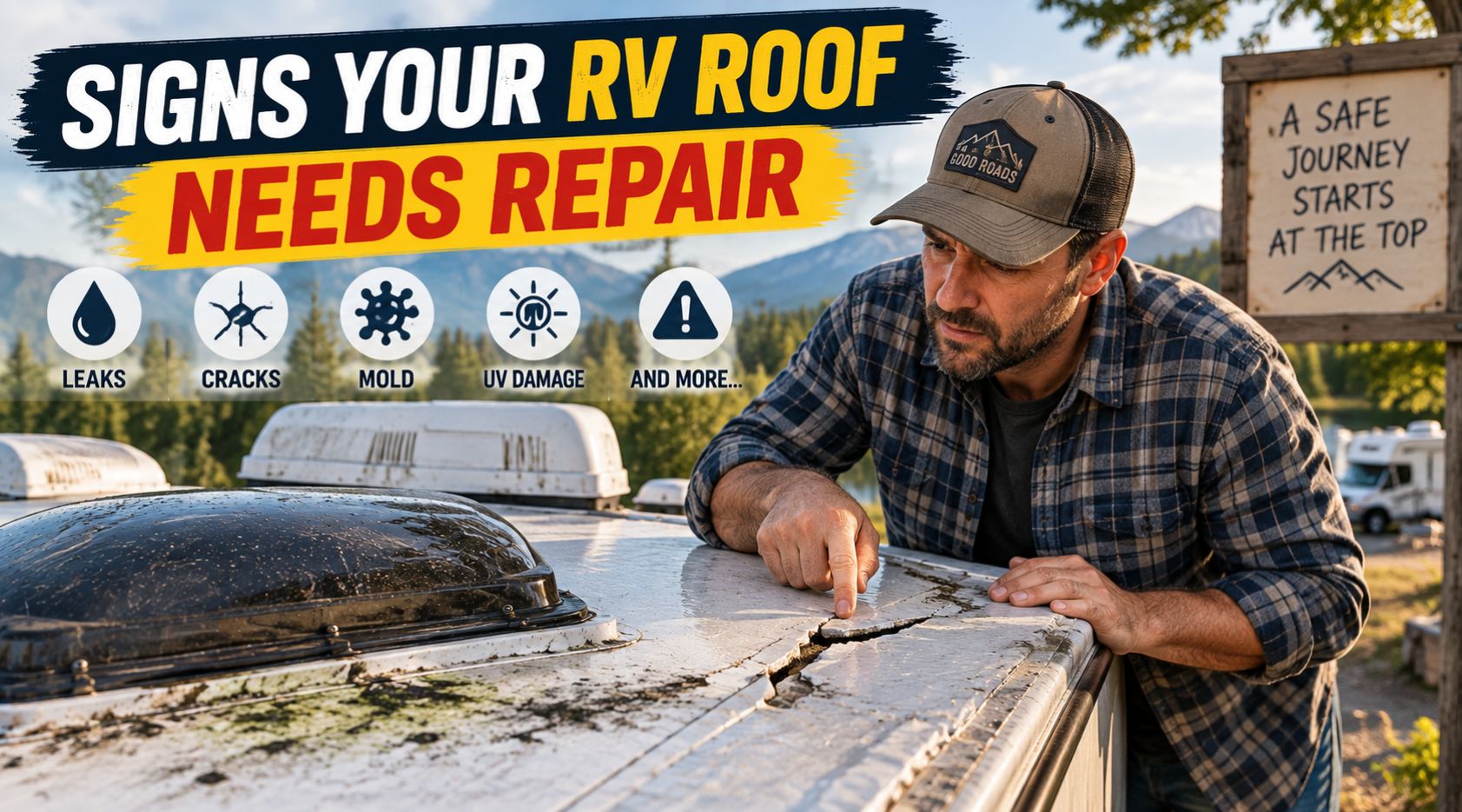
The clearest signs your RV roof needs repair are interior water stains, a musty smell, soft or spongy spots, visible sagging, and cracked or bubbling roof material. Soft spots and sagging mean water has already reached the roof decking and need immediate attention, while chalking, minor cracks, and worn sealant are earlier warnings worth fixing before they become bigger problems.
Roof damage rarely announces itself all at once. It shows up first as small, easy to dismiss details: a slight dullness in the roof color, a faint musty smell that fades once you air the place out, a hairline crack you tell yourself you’ll get to next weekend. By the time it’s obvious, water has usually already been getting in for a while.
This guide ranks the warning signs from most urgent to least, so you know exactly what needs a same-week fix and what you can reasonably schedule for your next maintenance pass.
How to Tell the Signs Your RV Roof Needs Repair Apart from Normal Wear
Not every roof issue carries the same urgency, and telling the signs your RV roof needs repair apart from ordinary cosmetic wear comes down to ranking them correctly. Instead of listing signs randomly, this guide is ordered from the most serious, meaning active structural or water damage, down to early warning signs that are still worth fixing but won’t cause immediate harm if you handle them on your next scheduled inspection.
1. Soft or Spongy Spots on the Roof
Urgency: Immediate. If you walk the roof and feel a section that gives, flexes, or feels spongy underfoot, water has already reached the decking beneath the membrane and started softening the wood or composite structure underneath. This isn’t a wait-and-see situation. Continuing to walk on a soft spot risks your safety, and the damage only spreads the longer it’s left alone.
2. Visible Sagging or Bulging
Urgency: Immediate. A roof that visibly dips, sags, or bulges, either from outside or when viewed against the ceiling from inside, points to a structural problem, usually extensive water damage that’s compromised the decking or framing. This typically requires professional evaluation rather than a DIY patch, since the extent of hidden damage isn’t always obvious from the surface.
3. Interior Water Stains or Active Dripping
Urgency: Immediate to urgent. Water stains on the ceiling, especially near vents, skylights, or seams, or actual dripping during or after rain, mean water is actively getting past the roof’s defenses right now. Water often travels along a rafter before showing up inside, so the stain isn’t necessarily directly below the actual entry point. If you’re dealing with this right now, our guide on what to do when your RV roof leaks after heavy rain walks through finding the source and stopping it.
4. A Persistent Musty or Moldy Smell
Urgency: Urgent. A musty odor, even without a visible stain, often means moisture is trapped somewhere you can’t see yet, inside a wall cavity or under the roof membrane. Mold and mildew thrive in these hidden, damp spaces, and by the time you can smell it, moisture has usually been present for a while. This is worth investigating promptly rather than just running a vent fan and hoping it clears up.
5. Bubbling or Blistering on the Roof Surface
Urgency: Urgent. Bubbles or blisters in the roof membrane indicate trapped moisture underneath the surface, pushing the material up as it sits there. This is common enough that it has its own set of causes and fixes, which our guide on why your RV roof is bubbling covers in more depth. Left alone, trapped moisture under a bubble tends to spread rather than resolve on its own.
6. Cracks, Tears, or Punctures in the Membrane
Urgency: Moderate to urgent, depending on size. A small hairline crack in sealant is a different situation than an actual tear or puncture straight through the roof membrane. Either way, both are direct paths for water, and both get worse the longer they’re exposed to rain and sun. Our breakdown of common causes behind RV roof cracking explains why this happens and how to catch it early.
7. Cracked, Shrinking, or Missing Sealant
Urgency: Moderate. Sealant around vents, skylights, antennas, and seams naturally breaks down from UV exposure and temperature cycling over time. Cracked or pulled-away sealant isn’t an emergency the moment you spot it, but it’s exactly the kind of small failure that turns into a much bigger leak once heavy rain or a storm tests it. This is one of the easiest and cheapest fixes on this entire list if you catch it early.
8. Chalking, Fading, or a Powdery Residue
Urgency: Moderate, watch closely. A powdery white residue that rubs off on your hand, along with dulling or fading color, signals that the roof coating or membrane itself is breaking down from UV exposure. This isn’t an active leak yet, but it’s a clear sign the roof’s protective layer is aging out and won’t hold up much longer without attention. Our guide on how long RV roof coating lasts can help you figure out where your roof likely stands in its lifespan.
9. Cold Drafts or Air Leaks Near Vents and Seams
Urgency: Minor to moderate. If you notice cold air entering near a roof vent, skylight, or seam, even without water intrusion, it usually means the seal in that spot has degraded enough to let air through, and where air gets in, water eventually follows. This is worth adding to your next inspection pass rather than ignoring indefinitely.
10. A Roof Nearing or Past Its Expected Lifespan
Urgency: Plan ahead. EPDM, TPO, and fiberglass roofs all have a general expected service life, and a roof that’s approaching or past that range, especially one that hasn’t had consistent maintenance, is statistically more likely to develop the other nine issues on this list. This isn’t a sign you need repair today, but it’s a reason to inspect more frequently and budget for eventual recoating or replacement rather than being caught off guard.
Signs at a Glance
| Sign | Urgency | Likely Cause |
|---|---|---|
| Soft or spongy spots | Immediate | Rotted decking from trapped water |
| Visible sagging or bulging | Immediate | Structural water damage |
| Interior stains or dripping | Immediate to urgent | Active leak somewhere on the roof |
| Musty or moldy smell | Urgent | Hidden trapped moisture |
| Bubbling or blistering | Urgent | Moisture trapped under the membrane |
| Cracks, tears, or punctures | Moderate to urgent | Physical damage to the membrane |
| Cracked or missing sealant | Moderate | Normal UV and age related wear |
| Chalking or fading | Moderate | Coating or membrane breaking down |
| Cold drafts near seams | Minor to moderate | Degraded seal allowing air through |
| Roof nearing expected lifespan | Plan ahead | General age and cumulative wear |
What to Do When You Spot One of These Signs
- Confirm what you’re dealing with. A visual inspection combined with a gentle press test on any soft-looking area tells you more than a glance from the ground.
- Address the urgent signs first. Soft spots, sagging, and active leaks take priority over cosmetic issues like chalking.
- Handle small, moderate issues promptly. Cracked sealant and minor cracks are cheap and easy fixes now, and expensive water damage later if ignored.
- Bring in a professional for structural concerns. Soft spots, sagging, and recurring leaks that keep coming back despite repairs usually need more than a DIY sealant fix.
- Build a regular inspection habit going forward. Our RV roof maintenance checklist and RV roof inspection checklist cover exactly what to check and how often, so these signs get caught early instead of after a storm.
When These Signs Point to Something Bigger Than the Roof
Some of these signs, especially musty smells and cracked seals, aren’t limited to the roof alone. Windows, doors, and slide-outs have their own seals that fail in similar ways and cause similar symptoms. Our RV seal inspection guide covers the rest of the RV’s exterior seals if you’ve ruled out the roof as the source and the smell or draft is still showing up somewhere.
FAQs
What is the most urgent sign that my RV roof needs repair?
Soft or spongy spots and visible sagging are the most urgent, since both indicate water has already reached and damaged the roof decking or structure underneath.
Can I fix RV roof damage myself?
Small sealant cracks, minor surface repairs, and touch-ups are usually manageable DIY tasks. Soft spots, sagging, structural damage, and recurring leaks are better handled by a professional.
How do I know if my roof leak is serious?
If you see active dripping, a stain that’s growing over time, or a musty smell that doesn’t clear up, treat it as serious and investigate right away rather than waiting for your next scheduled inspection.
Is chalking on my RV roof a serious problem?
Not immediately, but it does mean the roof’s protective coating is breaking down. It’s worth addressing before it progresses into cracking or reduced UV protection.
How often should I check my RV roof for these signs?
A full inspection every three to six months is a reasonable baseline, along with a check after any major storm or before and after your main travel season.
Should I call a professional or try to repair it myself?
For cosmetic or minor sealant issues, DIY repair is usually fine. For soft spots, sagging, structural concerns, or leaks that keep returning after repairs, a professional inspection is worth the cost to avoid missing hidden damage.
Final Thoughts
Walk your roof this week and check for even one of these ten signs. Catching a small crack or a patch of chalking now is far cheaper than dealing with a soft spot or sagging ceiling later.
Most RV roof problems don’t start as emergencies, they start as small, easy to overlook details that get worse with time and weather. Learning to recognize these ten signs, and understanding which ones demand immediate action versus which ones you can plan around, is what actually keeps a small repair from turning into a major, expensive one.