
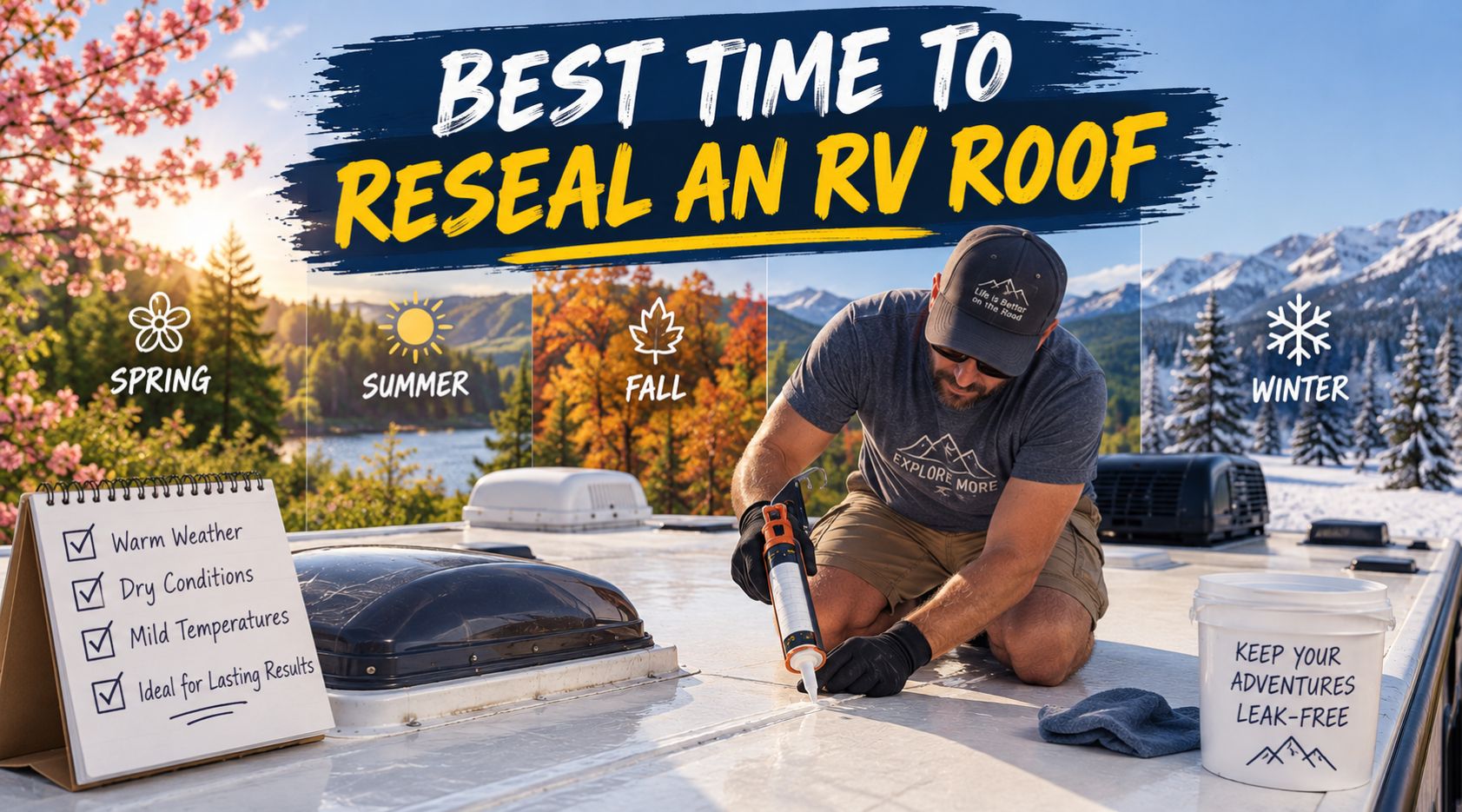
The best time to reseal an RV roof is on a dry day with temperatures between 50 and 80 degrees Fahrenheit, applied during the cooler morning or evening hours rather than direct midday sun. Spring and fall are generally the best seasons, since summer heat can cause sealant to skin over too fast and winter cold prevents it from curing properly.
Most RV owners focus on how often to reseal their roof, and that matters, but timing matters just as much. Applying sealant or coating under the wrong conditions, too hot, too cold, too humid, or in direct sun, can quietly ruin an otherwise good repair before it even has a chance to fully cure. Getting the timing right is one of those small details that separates a reseal job that holds up for years from one that starts failing within months.
Here’s how we approached this: we looked at the temperature and curing guidance from major sealant and coating manufacturers, compared seasonal recommendations from RV service technicians, and pulled together what actually affects how well sealant bonds and cures once it’s applied.
Why Timing Affects a Roof Reseal So Much
Sealants and coatings are chemical products, and like most chemical processes, temperature and moisture directly affect how they cure. Apply sealant when it’s too hot, and the surface layer can skin over before the material underneath has had a chance to bond properly, trapping uncured product beneath a dry-looking top layer that looks finished but isn’t. Apply it when it’s too cold, and the curing process slows dramatically or may not complete at all, leaving the sealant soft, weak, or prone to early cracking. Humidity and rain introduce moisture that can interfere with adhesion entirely, especially in the first several hours after application.
None of this is really about convenience, it’s about giving the product the conditions it was chemically formulated to cure under. Skipping this step is one of the more common, avoidable reasons a reseal job fails earlier than it should.
The Ideal Temperature Range for Resealing an RV Roof
Most sealant and coating manufacturers recommend applying their products somewhere between 50 and 80 degrees Fahrenheit. Below that range, curing slows down significantly or may not happen at all, particularly in freezing or near-freezing conditions. Above that range, especially in direct summer sun where roof surface temperatures can run well above the surrounding air temperature, the product can dry too quickly on the outside while remaining uncured underneath.
It’s worth checking your specific product’s label, since some coatings have a wider or narrower ideal range, and some also specify a minimum temperature for storing the product itself before application, often somewhere around 40 to 90 degrees Fahrenheit.
Best Time of Day: Morning or Evening, Not Midday
Even within a day that falls in the right temperature range, timing still matters. A roof sitting in direct midday sun can reach surface temperatures well above the surrounding air, even on a mild day, which pushes it outside the ideal application window even when your weather app says otherwise. Early morning or early evening, when the roof surface has cooled and direct sun isn’t beating straight down on it, tends to give sealant and coating the most stable conditions to begin curing.
Best Season: Spring and Fall
Spring and fall consistently come up as the preferred seasons for resealing, and for good reason: both tend to offer the mild, moderate temperatures that fall within the ideal curing range without the extremes of summer heat or winter cold.
Spring is particularly popular because it lines up naturally with pre-season prep. Checking and resealing your roof before your main travel season starts means you’re heading into your busiest camping months with fresh, properly cured protection already in place.
Fall works well for the opposite reason, it’s your last realistic window before winter temperatures make proper curing difficult, and catching any damage from a summer of travel and sun exposure before it sits through freezing temperatures is a smart way to head into the off-season.
Summer isn’t off-limits, but it requires more care around timing within the day, sticking to early morning or evening rather than midday heat, and avoiding the most intense heat waves in your region.
Winter is generally the season to avoid entirely in most climates, since cold temperatures interfere with curing regardless of what time of day you apply the product.
So, When Is the Best Time to Reseal an RV Roof?
Putting the temperature, time of day, and seasonal guidance together, the best time to reseal an RV roof is a dry morning or evening in spring or fall, with temperatures sitting comfortably in the 50 to 80 degree range and no rain in the forecast for at least the next day or two. That combination gives the sealant or coating the best possible conditions to bond and cure exactly the way it was formulated to.
Weather Conditions to Watch For
Beyond temperature and season, a few other weather factors matter just as much:
- Dry forecast. Check for at least 24 to 48 hours without rain after application, since most sealants and coatings need that window to properly cure before they’re rain resistant. Check your specific product’s cure time, since this varies.
- Low humidity. High humidity slows curing and can affect how well the product bonds to the surface, similar to how it affects paint and other coatings.
- No high wind. Wind can blow debris into wet sealant or coating before it cures, and it can also accelerate drying unevenly across the surface.
Seasonal Comparison at a Glance
| Season | Typical Conditions | Suitability for Resealing |
|---|---|---|
| Spring | Mild temperatures, moderate humidity | Excellent, ideal pre-season timing |
| Summer | Hot, intense midday sun | Workable with early morning or evening application |
| Fall | Mild temperatures, cooling trend | Excellent, ideal pre-winter timing |
| Winter | Cold, often below curing threshold | Generally avoid, unless your climate stays mild |
What Happens If You Reseal at the Wrong Time
Applying sealant or coating outside the recommended conditions doesn’t always fail immediately, which is part of what makes it a sneaky problem. A rushed application in extreme heat might look dry and complete within an hour, while the layer underneath is still uncured, only to crack, peel, or fail within months instead of lasting the years it should have. Cold-weather application can leave sealant permanently softer and less durable than a properly cured version of the same product. Either way, you end up doing the job again sooner than expected, which costs more time and materials than just waiting for better conditions in the first place.
How to Plan Your Reseal Timing
- Check your specific product’s temperature and cure time requirements, since these vary between sealants, tapes, and coatings
- Watch the extended forecast, looking for a dry stretch that covers the full cure window, not just the day of application
- Plan for early morning or evening application, even on a day with a good overall temperature range
- Favor spring or fall scheduling when possible, building it into your seasonal maintenance routine rather than treating it as an emergency task
- Don’t rush a job into a bad weather window just because you’re leaving on a trip soon, a short delay is cheaper than redoing the work later
If you’re trying to figure out how often you need to do this in the first place, our guide on how often you should reseal an RV roof covers that separately from timing, based on your specific roof material and climate. And if you’re not sure whether your roof needs a spot reseal or a full coating this season, our comparison of RV roof coating vs sealant can help you decide which one fits the repair.
Does Roof Material Change the Ideal Timing?
Not significantly. EPDM, TPO, fiberglass, and aluminum roofs generally follow similar temperature and weather guidelines for resealing, since the limiting factor is really the sealant or coating product curing correctly, not the roof material itself. What does change by material is how often you’ll be doing this in the first place, and how long a given coating is expected to last once properly applied. Our breakdown of how long RV roof coating lasts covers that side of the equation in more detail.
Should You Build This Into a Seasonal Routine?
Yes, and this is really the most practical takeaway here. Rather than treating resealing as a reactive task you scramble to fit in whenever you notice a problem, building it into a predictable spring or fall routine means you’re far more likely to catch the right weather window naturally, without rushing a job into conditions that shorten its lifespan. Pairing this with a full inspection each season, checking seams, vents, and skylights while you’re already up there, makes the whole process more efficient. Our RV roof maintenance checklist walks through a full seasonal schedule if you want to build resealing into a broader routine rather than handling it as a standalone task.
FAQs
What is the best temperature to reseal an RV roof?
Between 50 and 80 degrees Fahrenheit is the ideal range for most sealants and coatings. Below that, curing slows or stalls, and above it, the product can dry too fast on the surface before fully bonding underneath.
What time of day is best for resealing an RV roof?
Early morning or evening, when the roof surface is cooler and not in direct midday sun, gives sealant and coating the most stable conditions to begin curing properly.
Is spring or fall better for resealing an RV roof?
Both work well, and the better choice often comes down to your travel schedule. Spring lines up with pre-season prep before your main camping months, while fall gives you a last chance to address wear before winter.
Can I reseal my RV roof in the winter?
It’s generally best avoided in most climates, since cold temperatures interfere with proper curing regardless of the time of day. If you live somewhere with consistently mild winters, it may still be workable.
How long does sealant need dry weather after application?
Most products need at least 24 to 48 hours without rain to cure properly, though this varies by product, so checking your specific sealant or coating’s label is worth doing before you start.
What happens if I reseal my roof in bad weather?
The sealant may look dry on the surface while remaining uncured underneath, which often leads to early cracking, peeling, or failure well before the product’s expected lifespan.
Final Thoughts
Check tomorrow’s forecast before you commit to a reseal this weekend. A dry, mild day beats a rushed job squeezed into the wrong weather every time.
Getting the timing right on an RV roof reseal isn’t complicated, it just requires paying attention to temperature, time of day, and the weather forecast rather than squeezing the job in whenever it’s convenient. A properly timed reseal, done in the right conditions, holds up far longer than a rushed one, which means less maintenance overall and fewer surprises the next time it rains.