On this page1 sections
It’s a Whole New Ballgame When It Concerns Concrete Restoration
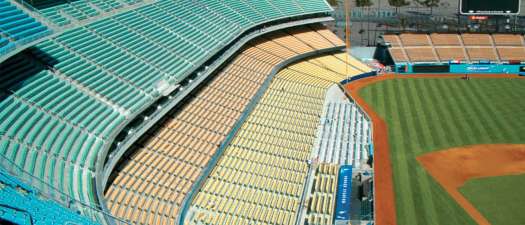
PITTSBURGH, Pa– Given that it opened in 1962, Dodger Stadium has actually hosted a few of the most exciting sports and entertainment occasions in history. More than 100,000,000 fans have stomped their feet when the likes of Don Drysdale struck out another batter, or Maury Wills stole another base. They’ve jumped up and down when headliners like The Beatles and the Rolling Stones took the stage. And they have actually marched happily when the venerable arena hosted Opening Ceremonies for the U.S. Olympic Festival. These billions of steps– and a fair share of beer, soda, and mustard spills– caused the concrete surface to fall into disrepair. Ultimately, Arena authorities called a conference on the mound.
It looked like the bottom of the ninth in the spring of 1999. Dodger Arena management chose they required a long ball to keep the house group looking great. They took a big swing and created precisely what they needed– a tactical plan that would lead to a massive, seven-year arena revitalization program.
They Contacted The Heavy Hitters
A complete roster of tradesmen was slated to be part of the remodelling group. However prior to the concrete restoration began, management hired D7 Consultants to establish the issues and recommend a solution. The condition of the concrete was unpleasant. In particular areas it had weakened to the point where steel rebar was visible. In addition, cracks in the seating areas had the potential of triggering water damage to the floorings listed below. According to Stadium owner, Frank McCourt, the objective was to “bring the life back to the concrete so it would be able to endure another 50 years of active usage.”
In the 2004 off-season, producer ArmorThane Products of Sante Fe Springs, California and coatings specialist Ingenious Painting and Waterproofing of neighboring Brea were asked to carry out a test on a 25,000-square-foot area of the Stadium. They recommended ArmorThane -Staingard 6072, an extremely resilient item that is made using polyaspartic coating technology from Bayer MaterialScience.
” We picked this topcoat due to the fact that it is stain-, UV-, and abrasion-resistant, and it will guarantee a long-lasting– and attractive– surface for several years to come,” comments Ashish Dhuldhoya, senior vice president, ArmorThane Products. “Furthermore, we were able to make a small adjustment in the formula to produce an item that is likewise exceptionally flexible, permitting it to much better fill in surface cracks.”
After speeding up the wear-and-tear factor in this location of the Arena, management concurred that the polyaspartic coating was just the ticket. Following the group’s 2005 season, ArmorThane and Ingenious returned to the plate to provide more polyaspartic coating for extra concrete refinishing.
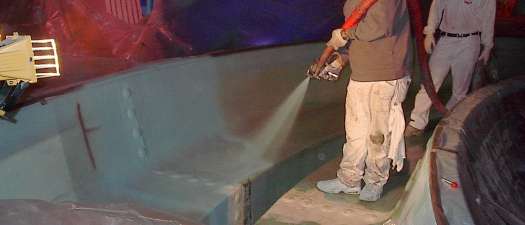
After repairing especially bad locations, the surface area was steam-cleaned and primed before the ArmorThane polyaspartic overcoat was used. Donald Dancey of Innovative Painting notes, “The ArmorThane product was an excellent option for our airless spray applicators. It dries very rapidly, and goes on quickly, even under humid conditions. This was key on this job website, due to the fact that we were following other trades, and other trades were following us. We had to work rapidly and yet do the job right.”
Another major benefit of the polyaspartic innovation from Bayer Material Science was the capability to use the topcoat to a defined density. A 14-mil-thick application of ArmorThane 6072 was defined for this specific application, and modern equipment on Ingenious’s pump recorded every stroke.
Great Game Analysis
Similar To Big league supervisors analyze every fact related to their game, Innovative Painting scrutinized every aspect of the coating procedure. “Computer information recorders on all of our pumps monitor specific pump strokes and, therefore, polyurea quantities,” Dancey discusses. “Thanks to this innovation, we can track pressures and temperatures, and control density using fundamental protection formulas.”
There’s no doubt that this kind of play-by-play analysis combined with the synergy of Innovative Painting and Waterproofing, ArmorThane and Bayer Material Science kept the Dodger Stadium managers delighted. McCourt was pleased to be able to bring back the venerable stadium to its former magnificence. “We see this as everyone’s 2nd home, and the pride of L.A.,” McCourt says. In addition, thanks to the remodelling, countless fans will have the ability to enjoy this fantastic home entertainment place for many years to come.
For more information on ArmorThane Products, visit www.ArmorThane.com.
To learn more on Dodger Arena call 323-224-1500 or visit www.dodgers.com. To find out more about Bayer MaterialScience’s polyaspartic coating technology,
Bayer Product Science LLC is among the leading manufacturers of polymers and high-performance plastics in The United States and Canada and becomes part of the international Bayer Product Science company with 18,000 staff members at 40 websites around the world and 2004 sales of 8.6 billion euros. Our innovative developments in coating, adhesive, and sealant raw materials, polycarbonates, polyurethanes, and thermoplastic urethane elastomers enhance the style and functionality of products in a wide range of markets, consisting of the automobile, building, electrical and electronic devices, family, and medical markets, and the sports and leisure fields. Our inorganic basic chemicals system produces chlorine and associated important items for the chemicals market. Let us give life to your vision. Bayer Material Science – Where VisionWorks.
Bayer Corporation, headquartered in Pittsburgh, becomes part of the worldwide Bayer Group, a worldwide healthcare, nutrition and ingenious materials group based in Leverkusen, Germany. In The United States and Canada, as of April 2005, Bayer employeed about 16,000 and had net sales of 8.3 billion euros. Bayer’s 3 operating companies– Bayer Health care LLC, Bayer CropScience LP and Bayer MaterialScience LLC– enhance individuals’s lives through a broad series of vital products that assist diagnose and deal with illness, secure crops and advance automobile security and sturdiness.
This news release contains positive declarations based upon existing assumptions and projections made by Bayer Group management. Different recognized and unidentified threats, uncertainties and other factors could lead to product distinctions in between the real future results, monetary scenario, advancement or efficiency of the business and the price quotes offered here. These elements include those discussed in our public reports filed with the Frankfurt Stock Exchange and with the U.S. Securities and Exchange Commission (including our Kind 20-F). The business assumes no liability whatsoever to update these forward-looking declarations or to adhere them to future events or developments.
Restoration of the concrete decking became part of a seven-year revitalization program at the venerable Dodger Stadium. According to Stadium owner, Frank McCourt, the objective was to “bring the life back to the concrete so it would have the ability to endure another 50 years of active usage.”
Frequently asked questions
What coating was used for Dodger Stadium waterproofing?
A polyaspartic topcoat. It was picked because it resists stains, UV and abrasion, and the formula was adjusted to make it more flexible so it would fill surface cracks better. It went on at a specified 14 mils over concrete that had already been repaired, steam-cleaned and primed.
Why did Dodger Stadium's concrete need restoring?
Wear, mostly. Since the stadium opened in 1962, more than 100 million fans had walked, jumped and spilled drinks and food on the concrete. By the time consultants assessed it, some areas had worn far enough to expose steel rebar, and cracks in the seating areas could let water through to damage the floors below.
How was the coating applied at Dodger Stadium?
Crews first repaired the worst areas, then steam-cleaned and primed the concrete. The polyaspartic topcoat went on with airless spray equipment. The contractor said it dried fast and went on quickly even in humid weather, which mattered because other trades were working right ahead of and behind the coating crew on a tight schedule.
How thick is the Dodger Stadium concrete coating?
The spec called for 14 mils. To hit it, the applicator ran computer data recorders on its pumps that logged every pump stroke along with pressures and temperatures. Tracking material volume that closely let the crew control thickness across a large area instead of estimating it by eye.
When was Dodger Stadium's concrete waterproofed?
It was part of a seven-year revitalization program that stadium management planned in spring 1999. A 25,000-square-foot test section was coated during the 2004 off-season, and after that area held up under accelerated wear testing, the crew came back following the 2005 season to coat more of the concrete.
Did this guide help with your rig?

Written by